What this page covers
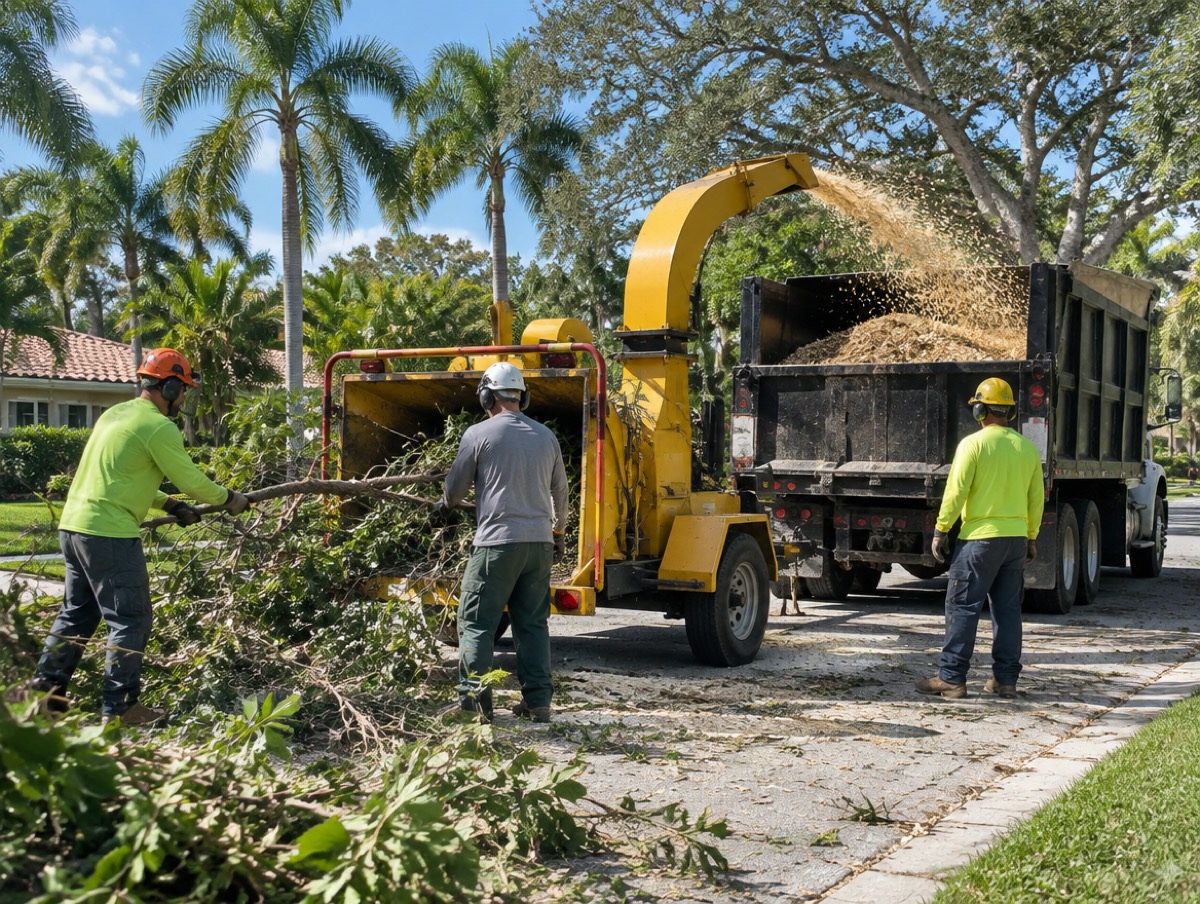
This is for yard-sized jobs: an overgrown backyard, a side lot that went wild, underbrush and vines under trees you want to keep, and a handful of small trees with the stumps that go with them. A tree crew with saws, a chipper and sometimes a small loader can handle that kind of work.
Bigger ground is a different trade. If you're clearing acreage, reclaiming pasture or opening up a wooded lot to build on, that's work for a land clearing contractor with forestry mulchers and track loaders. Mention the acreage when you call, and the request goes to that kind of contractor instead of a tree crew.
Clearing raises a permit question
In unincorporated Brevard, including Merritt Island, the county requires a permit before any land clearing unless the property is exempt, and it defines land clearing to include removing or cutting down vegetation, trees included, and root-raking (Brevard County Code s. 62-4337).
For a modest job there's a small scale land clearing permit, an administrative waiver that allows removing up to 50% of the understory or 1 acre, whichever is less, and up to 10% of the native canopy. It expires 30 days after it's issued, only one is approved per property per calendar year, and specimen trees can't be approved for removal (Brevard County Code s. 62-4338).
Palm Bay requires a permit for any land clearing on a residential lot under 1 acre, and the application needs a site sketch with the diameter and species of every tree on the parcel (Palm Bay Code s. 175.014). Removing only underbrush falls under the city's separate grubbing permit, which allows hand clearing, roto-chopping or mulching in place, and which exempts single- and two-family sites under 1 acre and areas of a quarter acre or less (Palm Bay Code s. 175.015).
Rockledge doesn't allow trees to be removed from a site before it's developed, except exempt species (Rockledge LDR ss. 108-51 and 108-52). Other cities have their own rules, collected in the permit guide. Ask the crew who applies for any permit and whose name goes on it.
Look for wildlife before anything moves
Sandy Brevard lots are gopher tortoise ground. The tortoise is a state-designated threatened species, and its burrows can't be damaged or destroyed without an FWC permit (FWC gopher tortoise rules). Clearing, digging or site prep within 25 feet of a potentially occupied burrow needs a permit. If every part of the work stays at least 25 feet from burrows and tortoises, it doesn't (FWC gopher tortoise permits).
Surveys and relocation are for an FWC Authorized Gopher Tortoise Agent, or for a landowner with 10 or fewer burrows who completes FWC's e-learning course and gets that permit. Off-site relocation always takes an Authorized Agent (FWC 10 or Fewer Burrows permit). This service doesn't arrange either. If you see a burrow, flag it and point it out before work starts.
Scrub is the other flag. The Florida scrub-jay is federally threatened and lives in sand pine and xeric oak scrub and scrubby flatwoods (FWC Florida scrub-jay profile), and USFWS has published notices of incidental take permit applications for clearing single-family lots in Palm Bay (Federal Register, May 11, 2006). Melbourne's code bars trimming, removing or altering vegetation in designated occupied scrub-jay and gopher tortoise habitat without USFWS approval (Melbourne LDC s. 9.272). A big stick nest nearby matters too: FWC recommends a 660-foot buffer from bald eagle nests before land clearing (FWC bald eagle FAQs).
Invasive plants usually go first
Brazilian pepper, melaleuca and air potato are all FISC Category I invasives (UF/IFAS, Brazilian peppertree, melaleuca, air potato). In unincorporated Brevard, removing nonnative invasive plants is exempt from the clearing rules, except inside shoreline protection buffers, the Coastal Construction Setback Line and wetlands, where the code requires hand clearing, leaving roots in the ground and aquatic-approved herbicide (Brevard County Code s. 62-4334). That matters on lagoon-front lots along the Indian River and the Banana River.
Pepper fights back. UF/IFAS says large stands resprout vigorously after cutting, so herbicide or stump treatment is usually needed. Ask the crew how they handle the stumps, and plan on a follow-up for sprouts. Satellite Beach went further and required Brazilian pepper, melaleuca and Australian pine to be removed citywide by January 8, 2016 (Satellite Beach Code s. 30-706).
Protect the trees you're keeping
Mark them before the crew arrives. In unincorporated Brevard the county counts soil compaction, trunk and root injury from machinery, stored materials, fuel or herbicide spills and grade changes over the roots as land clearing damage when they affect a tree's viability (Brevard County Code s. 62-4338). Ask the crew to keep machines and brush piles off the root zone of anything staying.
Where the brush goes
Most small clearing jobs end with the brush chipped and either hauled off or spread as mulch, and the stumps ground (see stump grinding). Open burning is regulated, and Brevard bans it automatically when the county's drought index average reaches 500 (Brevard County Code s. 50-1). This service doesn't arrange burning. The debris hauling page covers haul-away.
If the job includes grading or pulling stumps, Sunshine 811 has to be notified at least two full business days before digging (Sunshine 811 FAQs).
Questions people ask
Do I need a permit to clear my lot?
It depends on where the lot is, how big it is and what's coming out. The county, Palm Bay and the other cities each set their own rules. Check the permit guide, then confirm with the permitting office before work starts.
How big a job counts as small lot clearing?
Think yard-sized: a residential lot or the overgrown part of one, with brush, vines and smaller trees. For acreage, pasture or a wooded lot you're clearing to build on, mention it when you call so the request goes to a land clearing contractor.
What if there's a gopher tortoise burrow on the lot?
Keep all work at least 25 feet from it until the permit question is settled with FWC (FWC gopher tortoise permits). Surveys and relocation are done by an FWC Authorized Gopher Tortoise Agent, or under FWC's permit for owners with 10 or fewer burrows. This service doesn't arrange them.
Is Brazilian pepper removal allowed without a permit?
In Melbourne, Rockledge and West Melbourne it's exempt from the tree permit rules. In unincorporated Brevard, invasive removal is exempt except near shorelines, coastal setback lines and wetlands (Brevard County Code s. 62-4334). Check your own city before you start.
Will the stumps be ground?
Only if you ask for it. Make sure the estimate says whether stumps are ground, cut flush or left, and how deep. The stump grinding page has the details.
Sources
- Brevard County Code s. 62-4337, land clearing permits
- Brevard County Code s. 62-4338, land clearing performance standards
- Palm Bay Code of Ordinances s. 175.014
- Palm Bay Code of Ordinances s. 175.015 (grubbing permit)
- Rockledge LDR ss. 108-51 and 108-52
- FWC, Gopher tortoise rules and regulations
- FWC, Gopher tortoise permits
- FWC, 10 or Fewer Burrows permit
- FWC, Florida scrub-jay profile
- Federal Register, May 11, 2006, Palm Bay scrub-jay permits
- Melbourne LDC s. 9.272, tree removal permits
- FWC, Bald eagle frequently asked questions
- UF/IFAS Plant Directory, Brazilian peppertree
- UF/IFAS Plant Directory, Melaleuca
- UF/IFAS Plant Directory, Air potato
- Brevard County Code s. 62-4334, exemptions
- Satellite Beach Code s. 30-706, nuisance trees
- Brevard County Code s. 50-1, open burning
- Sunshine 811, frequently asked questions