Last reviewed October 7, 2026. General information, not legal or professional advice. Check the linked sources for the current rules.
Bald eagle nests
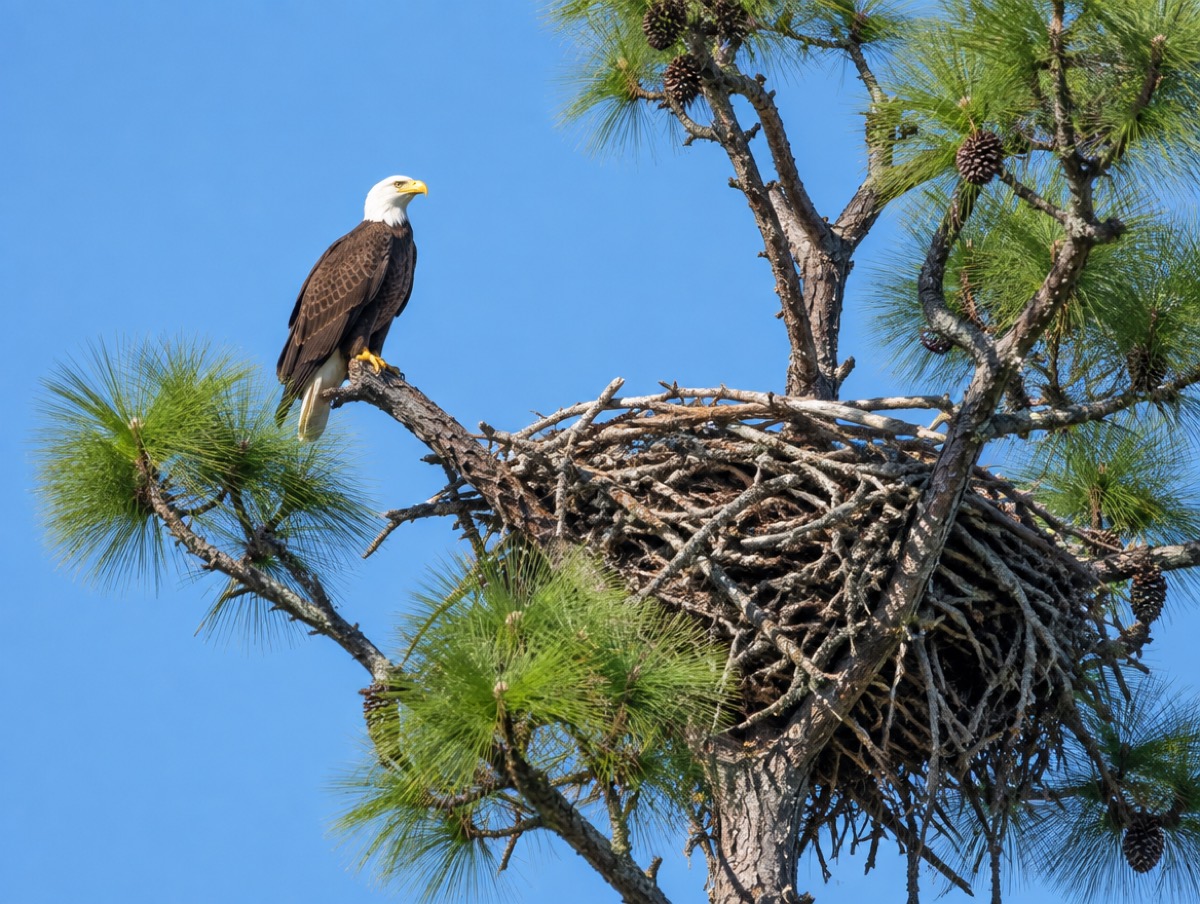
Bald eagles came off the federal endangered and threatened list in August 2007 and off Florida's threatened list on April 9, 2008. They're still protected by the state eagle rule (68A-16.002, F.A.C.), the Migratory Bird Treaty Act and the Bald and Golden Eagle Protection Act (FWC bald eagle FAQ).
FWC's recommended buffer from a nest is 660 feet. Before a project that could affect a nest, such as land clearing or construction, FWC suggests checking its Historical Bald Eagle Nesting Areas map. The map isn't comprehensive and doesn't replace an on-the-ground survey. Eagle permits go through the U.S. Fish and Wildlife Service's regional Migratory Bird Office (FWC).
For a homeowner it comes down to this. If there's a large nest in the tree or anywhere near the work, stop and check before anyone climbs. Drones count: FWC says not to fly one within 1,000 feet of an eagle nest during nesting season. A nest that isn't on the map can be reported to Audubon's EagleWatch program (FWC).
Hawks, ospreys and other raptors
All Florida raptors, their nests and their eggs are protected under the federal Migratory Bird Treaty Act and state law. Removing an active hawk nest, one with eggs or chicks, requires a permit from the U.S. Fish and Wildlife Service (FWC raptor permits).
An inactive nest of a non-listed hawk can be removed without a permit if no eggs or young are present, under Rule 68A-16.003. That rule doesn't cover nests of eagles, crested caracaras, snail kites or American kestrels, or ospreys in Monroe County (FWC).
FWC also notes that hawks guarding an active nest sometimes dive at people who come too close (FWC). One more reason to schedule the job after the young have left.
Mangroves on lagoon and canal lots
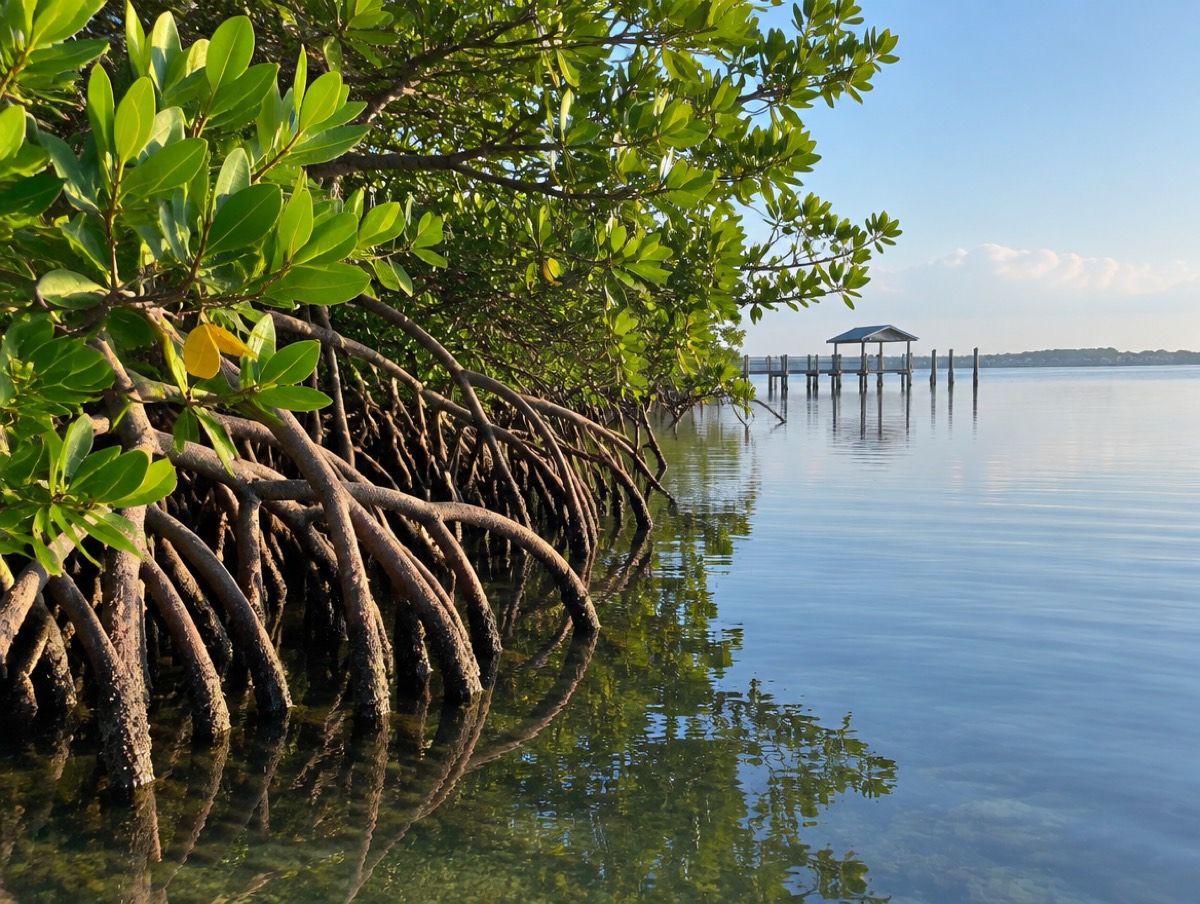
Mangroves fall under the Mangrove Trimming and Preservation Act, sections 403.9321 to 403.9333 of the Florida Statutes. The dangerous-tree exemption in F.S. 163.045 does not apply to them (F.S. 163.045), and Brevard's land clearing permit standards say mangrove trimming must follow state and federal rules (Brevard County Code s. 62-4338).
The state exemptions are narrow. The main owner exemption lets an owner trim the riparian mangrove fringe on their own shoreline without a permit when the mangroves are no taller than 10 feet before trimming, none is cut below 6 feet, no herbicide is used, and the shoreline is 150 feet or less. Owners of longer shorelines can't trim more than 65 percent of their mangroves under the exemption (F.S. 403.9326).
Taller mangroves, up to 24 feet, fall under a second exemption that requires a professional mangrove trimmer. Nothing can be cut below 6 feet, mangroves 16 feet or taller come down in stages of no more than 25 percent of the foliage a year, and a professional mangrove trimmer working on red mangroves for the first time under that exemption must notify the state or the delegated local government in writing at least 10 days ahead (F.S. 403.9326).
Professional mangrove trimmers include ISA certified arborists, professional wetland scientists and holders of certain other professional credentials, and the one who signs the notice of intent must do or supervise the trimming (F.S. 403.9329).
This site doesn't arrange mangrove trimming, and an ordinary tree crew should not trim mangroves at all. If mangroves are part of the project, start with a professional mangrove trimmer and the Florida Department of Environmental Protection.
Scrub-jay and gopher tortoise habitat
FWC lists the Florida scrub-jay as federally threatened. It lives in sand pine and xeric oak scrub and scrubby flatwoods on old sandy ridges, coastal dunes and river sand deposits, and FWC reports a 90 percent population decline over the past century (FWC scrub-jay profile). Melbourne's tree code bars trimming, removing or altering vegetation in designated occupied scrub-jay and gopher tortoise habitat without U.S. Fish and Wildlife Service approval (Melbourne LDC s. 9.272(a)(2)).
The gopher tortoise is a state-threatened species, and its burrows are protected (FWC gopher tortoise rules). FWC requires a permit for clearing, grading, digging or site preparation within 25 feet of a potentially occupied burrow (FWC gopher tortoise permits). Tree crews don't survey or move tortoises. That's work for an FWC Authorized Gopher Tortoise Agent, and FWC publishes a map to find one.
Trees protected by size
Some trees are protected for their size alone. In unincorporated Brevard, specimen trees are healthy hardwoods or softwoods of 24 inches dbh or more (s. 62-4332), and a small scale land clearing permit can't approve removing one (s. 62-4338(5)). Titusville's Heritage class starts at 46 inches dbh (Titusville LDR s. 30-31).
In Palm Bay, a violation can bring a restoration plan requiring one native canopy tree, at least 5 inches dbh and 15 feet tall, for every 6 inches of specimen trunk removed (Palm Bay Code s. 175.014). The permit guide covers the rest of the size rules.
A quick check before work near water or nests
Five minutes of checking can save a stop-work order. When the coast is clear, call or text (321) 604-1285 and we match you with an independent local crew.
- Look up the property on FWC's Historical Bald Eagle Nesting Areas map, then look up into the tree.
- Check for hawk or osprey nests with eggs or chicks before anyone climbs.
- If mangroves grow anywhere on the shoreline, read F.S. 403.9326 before anything near them is cut.
- If you see a tortoise burrow, keep all work at least 25 feet away and contact an FWC Authorized Gopher Tortoise Agent.
- In Melbourne, ask the city whether the lot is designated scrub-jay or tortoise habitat.
- Measure the trunk at 4.5 feet and compare it with your jurisdiction's thresholds.
Questions people ask
Can I remove a tree with an eagle nest in it?
Not on your own say-so. Eagles and their nests are protected by state and federal law, FWC recommends a 660-foot buffer, and eagle permits go through the U.S. Fish and Wildlife Service (FWC). Start there before any work is scheduled.
There's an empty hawk nest in my oak. Can it come down with the tree?
If it's inactive, with no eggs or young, and belongs to a non-listed hawk, FWC says it can be removed without a permit under Rule 68A-16.003. Eagle, caracara, snail kite and kestrel nests are excluded (FWC raptor permits).
Can I trim the mangroves along my seawall?
Only within the state exemptions, which limit the height of the mangroves, how low they can be cut and how much shoreline is trimmed (F.S. 403.9326). Taller mangroves need a professional mangrove trimmer. This site doesn't arrange mangrove work.
Does an arborist's risk letter cover mangroves?
No. F.S. 163.045 expressly does not apply to mangroves (F.S. 163.045).
Sources
- FWC, Bald Eagle Frequently Asked Questions
- FWC, Raptors and raptor nest permits
- Florida Statutes s. 163.045, Tree pruning, trimming, or removal on residential property
- Florida Statutes s. 403.9326, Mangrove trimming exemptions
- Florida Statutes s. 403.9329, Professional mangrove trimmers
- Brevard County Code s. 62-4338, Land clearing permit standards
- Brevard County Code s. 62-4332, Definitions
- FWC, Florida scrub-jay species profile
- Melbourne Land Development Code s. 9.272, Tree removal permits
- FWC, Gopher tortoise rules and regulations
- FWC, Gopher tortoise permits
- Titusville LDR s. 30-31, Definitions and tree classes
- Palm Bay Code s. 175.014, Tree removal and land clearing permits