Signs a tree may be failing
None of these means a tree is about to fall. Each one is a reason to get it looked at, and two or three together are a reason to do it soon.
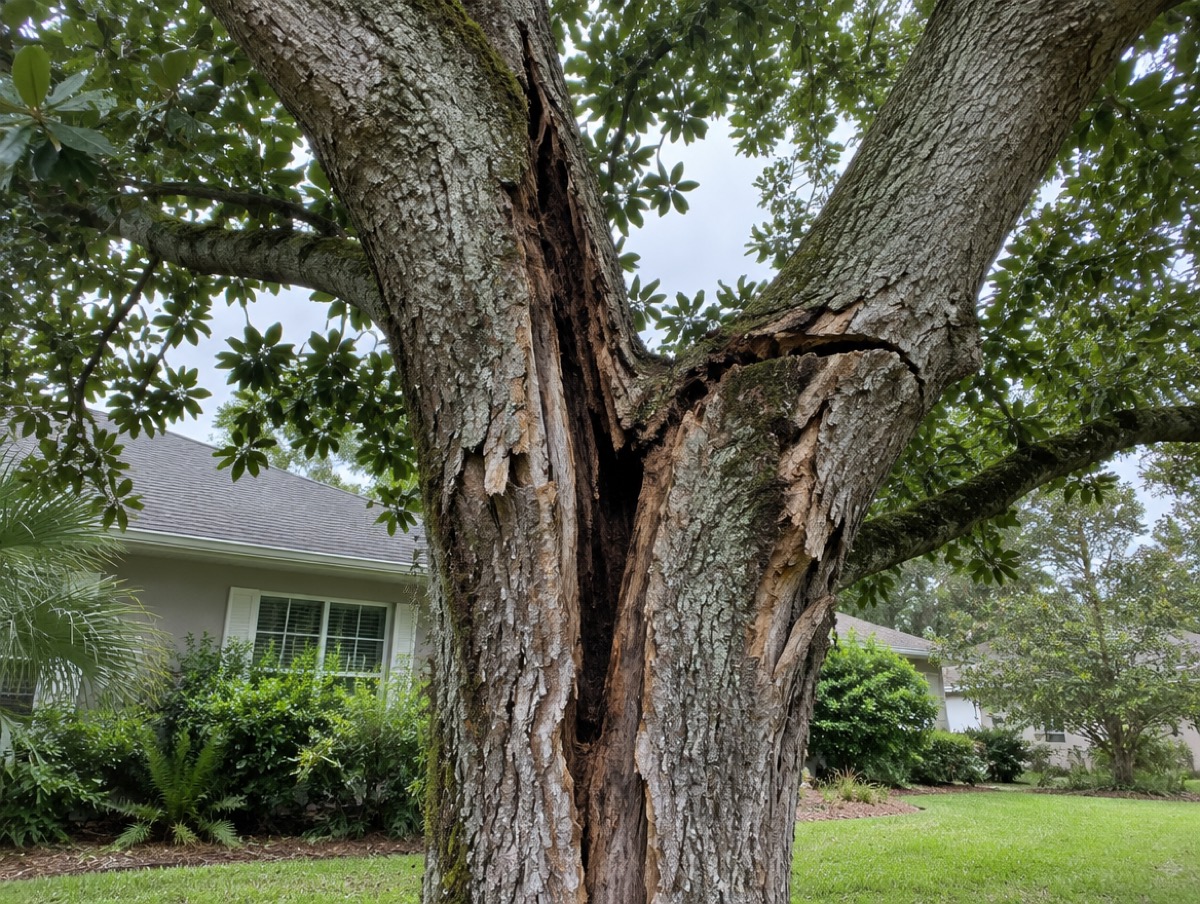
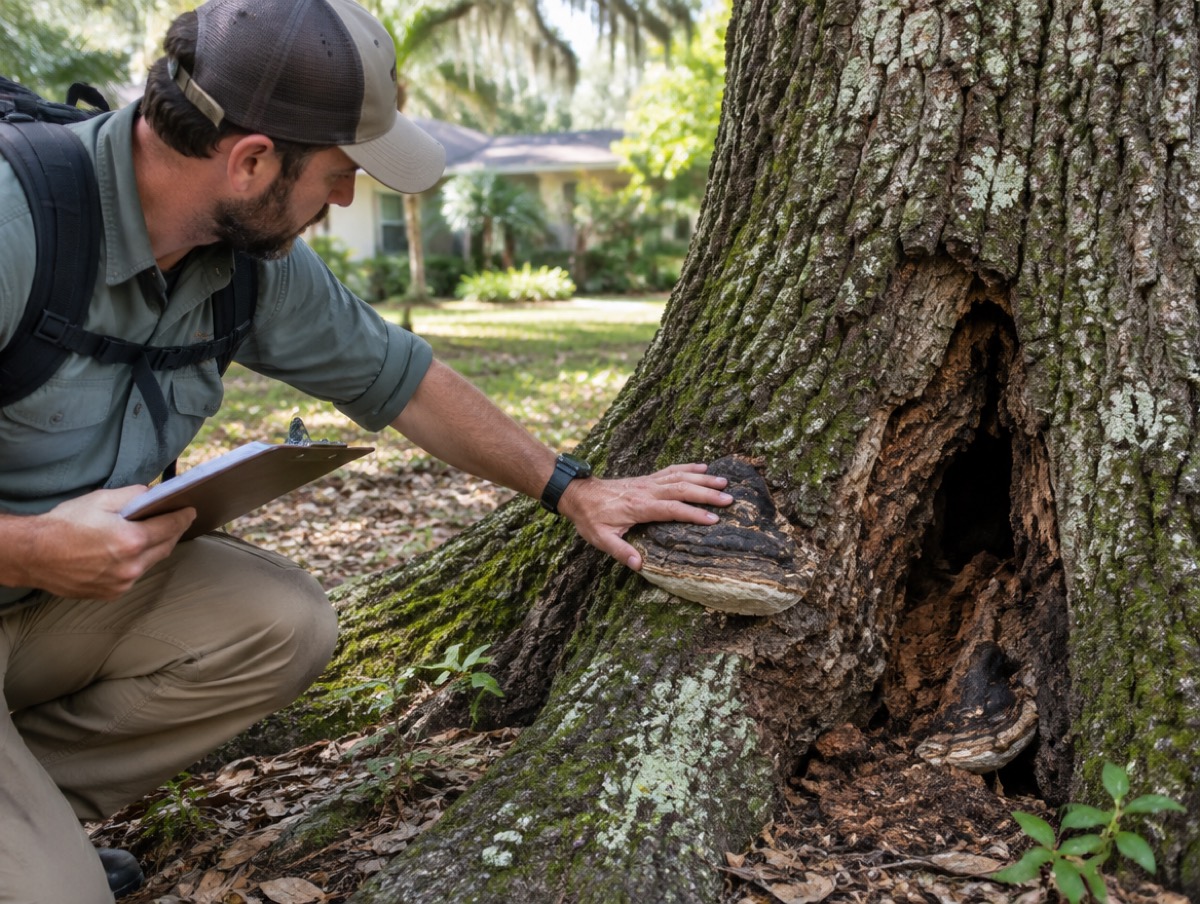
- A cavity, or soft and crumbly wood, in the trunk or a major limb
- Mushrooms or shelf-like fungus at the base or on the roots
- A crack running down the trunk, or a seam opening where two trunks meet in a tight V
- Large dead limbs, or a dead top
- A new lean, with soil heaving or cracking on the opposite side
- Roots cut by a trench, a new driveway or pool work in the last few years
- Broken limbs hung up in the canopy after a storm
Species matters
UF/IFAS notes that laurel oak is prone to breakage and that its trunk and large limbs often hollow from decay (UF/IFAS ST549). In its ratings of trees after hurricanes, laurel oak and sand pine came out lowest on the Southeastern Coastal Plain, while live oak, sand live oak and sabal palm came out highest (UF/IFAS FR173). A cavity in a live oak and a cavity in a laurel oak aren't the same conversation.
Florida's dangerous-tree law, in plain terms
Section 163.045 of the Florida Statutes says a city or county can't require a notice, application, approval, permit, fee or mitigation to prune, trim or remove a tree on residential property when the owner has documentation that the tree poses an unacceptable risk to people or property. The local government can't require replanting either (F.S. 163.045).
The definitions are narrow, and they're where people get caught out:
- "Documentation" means an onsite assessment done under the ISA Best Management Practices for tree risk assessment (2nd edition, 2017), signed by the assessor.
- "Unacceptable risk" means removal is the only practical way to bring the risk below moderate.
- "Residential property" means a single-family detached home on a lot actively used as one. Vacant lots, multifamily buildings and commercial sites aren't covered.
- Mangroves are excluded.
How Brevard cities read it
Local codes read it the same narrow way. Cocoa's code says residential property under the exemption doesn't include multifamily property, HOA or condo common areas, vacant residential land, rights-of-way, or land under a development agreement or a landscape or conservation easement (Cocoa Code, Appendix A, Art. XIII, s. 22). Palm Bay exempts developed single- and two-family lots that meet 163.045, provided the owner gives the city the documentation (Palm Bay Code s. 175.014).
Who can sign the documentation
The statute names two kinds of professionals: an ISA Certified Arborist or a Florida licensed landscape architect (F.S. 163.045). ISA certification is a private credential, not a state license. It lasts three years, it's renewed with continuing education credits or by retaking the exam, and ISA will verify a person's credential status for the public (ISA Certified Arborist application).
When you call, say that you need signed documentation and not only a removal price. Ask the crew you're matched with whether an ISA Certified Arborist or a licensed landscape architect will do the onsite assessment and sign it. If the answer is no, you can hire one directly and bring the crew in afterward for the work.
What an assessment settles, and what it doesn't
A risk assessment weighs how likely a tree is to fail, what it would hit, and how bad that would be. It may conclude that pruning, cabling or keeping an eye on the tree is enough. The statute is about local government permits. HOA rules and disputes with a neighbor are separate questions.
It also doesn't cover every property. A common-area oak in a condo complex or a pine on a vacant lot falls outside 163.045, so the normal permit rules apply. In unincorporated Brevard, a dead or seriously damaged tree that poses an immediate threat has its own emergency exemption, with photos and measurements taken first (Brevard County Code s. 62-4334).
Hazardous tree removal
If the answer is removal, the method follows the setting: dropped whole on open ground, taken down in pieces over a roof, or lifted out by crane. The tree removal and crane removal pages explain how those go.
Questions people ask
What is an arborist letter and when do I need one?
People use the phrase for the signed documentation section 163.045 describes: an onsite risk assessment, signed by an ISA Certified Arborist or a Florida licensed landscape architect, finding the tree poses an unacceptable risk. You need it when you want to take down a tree on a single-family lot under that section instead of the normal local permit process.
Can I remove a dead or dangerous tree without a permit in Florida?
Sometimes. On a single-family home lot, section 163.045 applies once you hold the signed documentation. Unincorporated Brevard also has an emergency exemption for a dead or seriously damaged tree posing an immediate threat, and Palm Bay allows removal of an immediate threat with on-site verbal authorization (Palm Bay Code s. 175.014). Confirm with your permitting office first.
How do I know if a tree is going to fall?
You can't know for certain, and neither can anyone else. What you can do is watch for the warning signs above and get a closer look when two or three show up together, especially on a laurel oak or a tree leaning toward the house.
Does 163.045 apply to an HOA common area or a vacant lot?
No. The statute covers a single-family detached home on a lot actively used as one, and it leaves out vacant lots, multifamily property and commercial sites. Cocoa's code also spells out that HOA and condo common areas aren't included (Cocoa Code).
Is ISA certification a state license?
No. It's a private credential from the International Society of Arboriculture. It's the credential section 163.045 names for risk documentation, alongside Florida licensed landscape architects, and ISA verifies credential status for the public (ISA).
Sources
- UF/IFAS, Laurel oak fact sheet (ST549)
- UF/IFAS, Wind and Trees: Lessons Learned from Hurricanes (FR173)
- Florida Statutes s. 163.045, tree removal on residential property
- Cocoa Code of Ordinances, Appendix A, Art. XIII, s. 22
- Palm Bay Code of Ordinances s. 175.014
- ISA, Certified Arborist application and requirements
- Brevard County Code s. 62-4334, exemptions