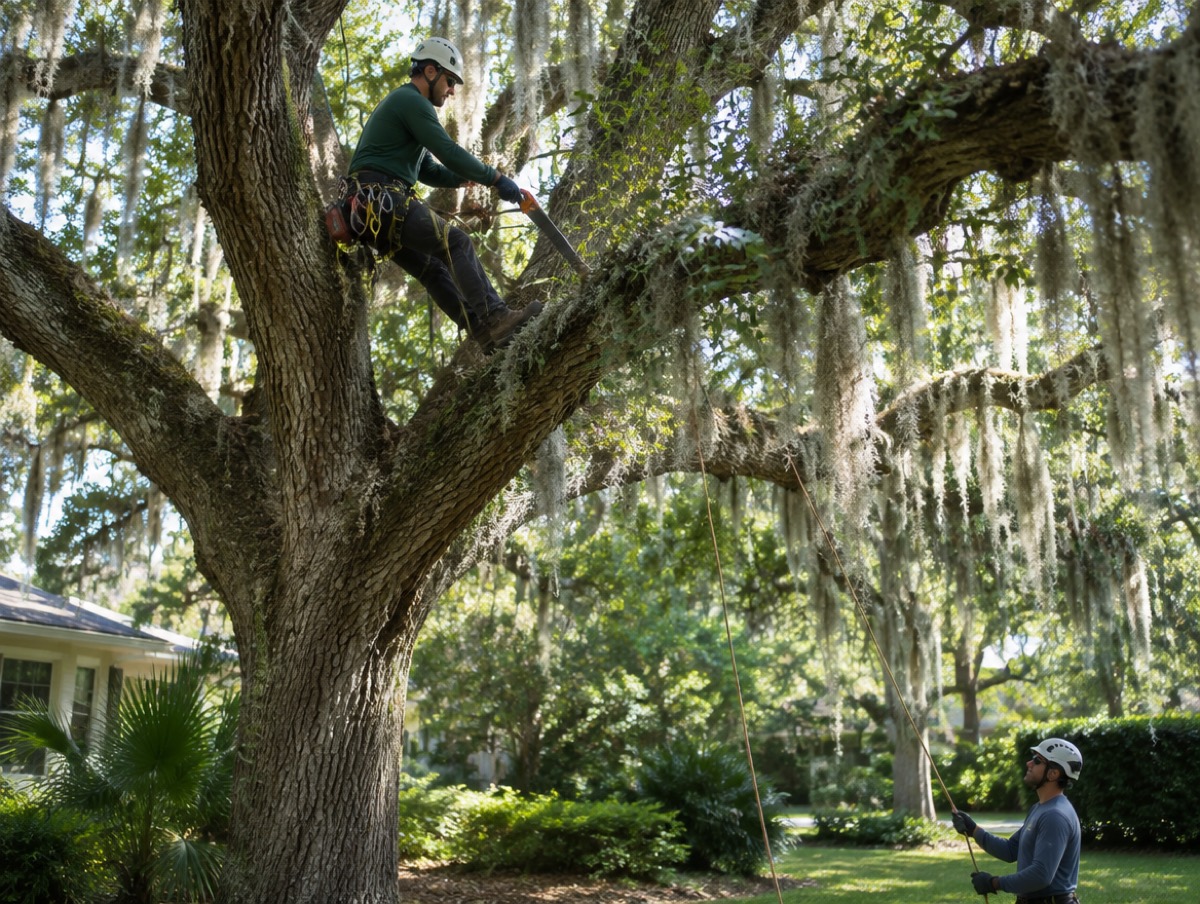
Trimming or pruning, it's the same job
People use the two words for the same thing, and so do most crews. What matters is which branches come off and where each cut is made. The usual requests in a Brevard yard look like this:
- Dead and broken limbs taken out before a storm drops them
- Low limbs lifted so the mower, the car and the garbage truck clear
- Branches pulled back off the roof, the gutters and the pool screen
- A dense live oak thinned so some light gets back to the grass
- Long limbs shortened where they reach over a fence or the street
- Dead fronds and seed stalks cut from palms (the palm page covers those)
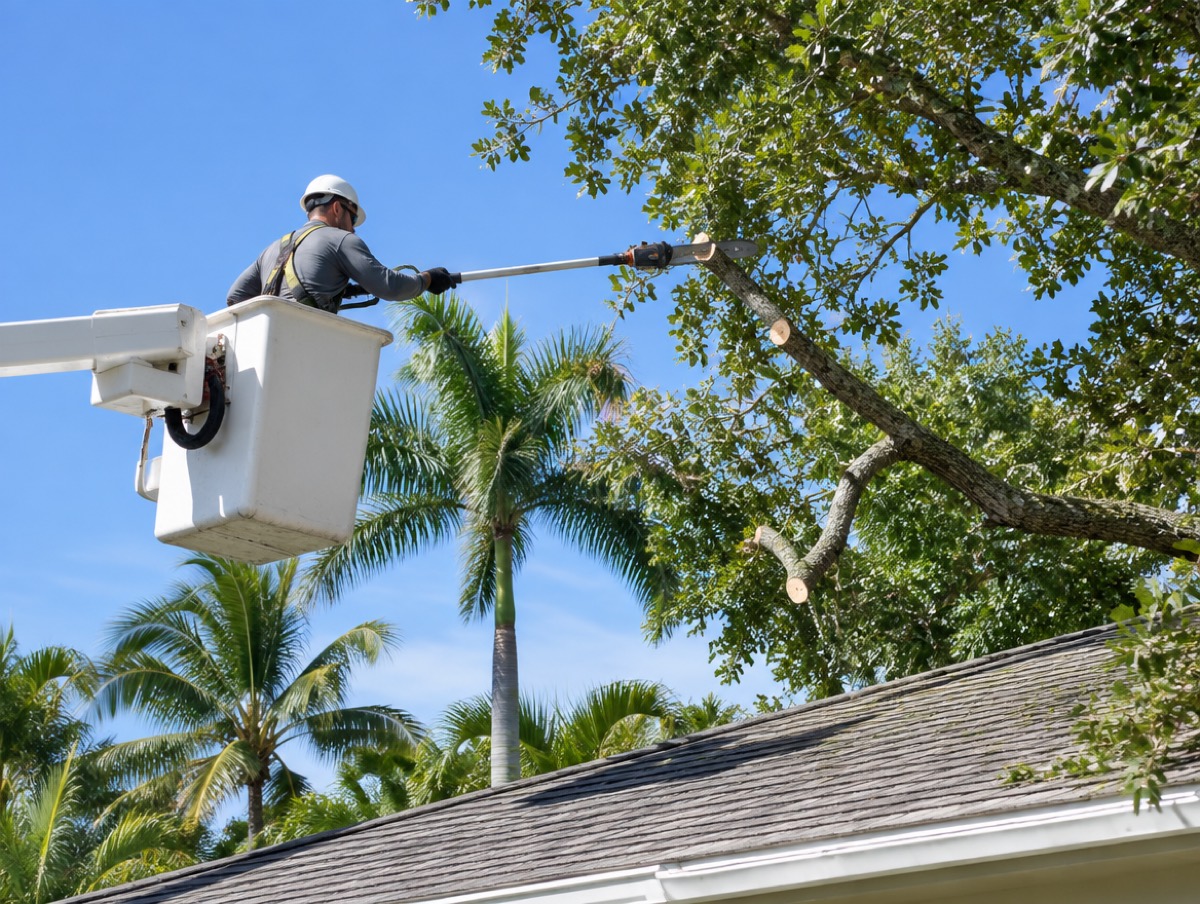
Where the cut goes matters
A good pruning job is hard to spot a month later. A bad one shows for years. Before anyone climbs, ask the crew where they plan to cut and how much of the live canopy will come off.
Laurel oak needs extra care. UF/IFAS notes that a small trunk injury or an improper pruning cut on this species can start a column of decay 10 to 20 feet long or more, and that its trunk and large limbs often hollow as it ages (UF/IFAS ST549).
In unincorporated Brevard, including Merritt Island, the county counts improper pruning that affects a tree's viability as a form of land clearing, along with machinery damage to roots and grade changes over the root system (Brevard County Code s. 62-4338). Over-cutting a tree there is more than a looks problem.
Permits and the 20 percent line
Ordinary trimming usually sits outside the permit rules, but check the details for your address. Brevard County's land clearing rules, which cover the unincorporated county and Merritt Island, leave allowable mowing, trimming and pruning out of the definition of land clearing (Brevard County Code, land clearing permits). West Melbourne's code says no notice, application, permit, fee or mitigation is required to prune, trim or remove a tree on a lot actively used as a single-family home (West Melbourne Code s. 71-110).
Melbourne sets a number. Trees there may be trimmed by up to 20% of the canopy without a permit (Melbourne LDC s. 9.272). If the plan is to take more than that, ask the crew to say so in writing, then check with the city before work starts.
Palm Bay is strict about damage. Its code requires a permit to remove or damage any tree 6 inches or more in diameter at breast height (Palm Bay Code s. 175.014), so a heavy cut on a big oak in Palm Bay is worth a call to the city first.
Nests, wires and the neighbor's side
Look up before you book. Florida's raptors, their nests and their eggs are protected, and removing an active hawk nest with eggs or chicks takes a federal permit (FWC raptor permits). A big stick nest could also belong to a bald eagle, which FWC protects separately (FWC bald eagle FAQs). If there's a nest in the tree, find out whose it is before anyone climbs.
Branches near power lines are a different job. FPL says only specially trained line-clearing professionals should work around power lines, and asks people to report trees touching lines (FPL tree FAQs). If a limb is on or near a line, report it to your electric utility and leave that part of the tree alone.
Then there's the neighbor's oak. Under the general rule UF/IFAS describes, you may trim branches that hang over your side back to the property line at your own expense, but removing a healthy boundary tree without the neighbor's consent can create liability (UF/IFAS FE962). That's general information, not legal advice.
Getting a useful price
Trimming quotes vary more than removal quotes, because "trim the oak" can mean an hour of deadwood or a full day in the canopy. Photos help. Stand back far enough to get the whole tree in one shot, then take a closer one of the limbs that bother you.
Tell us how wide the side gate is and whether a bucket truck could get near the tree from the driveway or the street. In older parts of Eau Gallie and Cocoa, where big oaks sit in narrow backyards, that answer decides whether the job is a bucket job or a climbing job.
Questions people ask
Is tree trimming the same as tree pruning?
In everyday use, yes. Some people say pruning for careful, selective cuts and trimming for general cleanup. What you want on the estimate is which limbs come off and how much live canopy goes with them.
When is the best time to trim trees in Florida?
Many people book before the peak of hurricane season. The season runs June 1 to November 30 and is busiest from August through October (NOAA Hurricane Research Division). Whatever the month, check for nests first. The trimming calendar guide goes further.
How much of a tree can be trimmed at one time?
Melbourne lets owners trim up to 20% of a tree's canopy without a permit (Melbourne LDC s. 9.272). Other codes may not set a number. Either way, ask the crew how much live canopy they plan to take and why.
Can I trim my neighbor's tree where it hangs over my yard?
As a general rule in Florida, you may trim overhanging branches back to the property line at your own expense, according to UF/IFAS. Taking down a healthy boundary tree without consent is a different matter (UF/IFAS FE962). Talk to the neighbor first, and treat this as general information, not legal advice.
Will trimming make a tree hurricane-proof?
No. UF/IFAS research on trees after hurricanes says no tree is wind-proof, though species differ a lot: live oak, sand live oak and sabal palm rated highest on the Southeastern Coastal Plain, and laurel oak and sand pine lowest (UF/IFAS FR173). Taking out deadwood and weak limbs reduces what can fall. It doesn't change the species.
Sources
- UF/IFAS, Laurel oak fact sheet (ST549)
- Brevard County Code s. 62-4338, land clearing performance standards
- Brevard County Code s. 62-4337, land clearing permits
- West Melbourne Code s. 71-110, tree permit exemptions
- Melbourne LDC s. 9.272, tree removal permits
- Palm Bay Code of Ordinances s. 175.014
- FWC, Raptor permits
- FWC, Bald eagle frequently asked questions
- FPL, Trees and power lines FAQ
- UF/IFAS, Handbook of Florida Fence and Property Law (FE962)
- NOAA Hurricane Research Division FAQ
- UF/IFAS, Wind and Trees: Lessons Learned from Hurricanes (FR173)