Last reviewed October 7, 2026. General information, not legal or professional advice. Check the linked sources for the current rules.
Know which palm you have
The sabal palm, or cabbage palm, is Florida's state tree (F.S. 15.031). UF/IFAS hurricane research puts it among the most wind-resistant trees in the Southeastern Coastal Plain, alongside live oak and sand live oak. The queen palm sits at the other end, rated lowest in the publication's tropical and subtropical table (UF/IFAS FR173).
UF/IFAS has also assessed the queen palm as potentially invasive and says to use it with caution. One fruit cluster can weigh over 100 pounds and carry more than 1,000 seeds, which is why queen palms seed the beds around them (UF/IFAS ST609).
Some palms clean themselves. Royal, foxtail and Christmas palms have a crownshaft, the smooth section below the fronds, and drop their old fronds about once a month, so there's no need to prune them (UF/IFAS Gardening Solutions). Mexican fan palms eventually become mostly self-cleaning too (UF/IFAS EP443).
How often to trim palms, and how much to cut
There's no set calendar. Trim when fronds have turned fully brown, or when flower and fruit stalks are in the way (Gardening Solutions, Pruning Palms).
UF/IFAS states the first rule plainly: never remove live, green, healthy fronds. Those leaves feed the palm, and cutting them opens wounds in the crown (Gardening Solutions, Pruning Palms).
Picture the canopy as a clock face. No frond with its tip above the horizontal, the 9 o'clock and 3 o'clock line, should come off (EP443). UF/IFAS calls that line the absolute limit, not the goal. The goal is a full, round head with green fronds low on it, and only fully brown fronds removed (Gardening Solutions).
Yellow and half-brown fronds are tempting. Leave them. They're often a sign of a nutrient deficiency, they still feed the palm, and cutting them erases the symptoms someone needs to see to diagnose the problem (Gardening Solutions). EP443 reports that repeatedly pruning potassium-deficient older leaves reduces the number of healthy green leaves in the canopy (EP443).
Flower and fruit stalks are a different story. UF/IFAS sees no evidence that removing them harms the palm (Gardening Solutions), so cutting queen palm fruit before it drops on the pool deck is fine.
Why the hurricane cut backfires
The hurricane cut strips a palm to a tuft of upright fronds, on the theory that less canopy catches less wind. UF/IFAS says the practice isn't rooted in science. Observations after Florida hurricane seasons found hurricane-cut palms were more likely to have their crowns snapped off by the wind (Gardening Solutions, EP443). Done again and again, over-pruning can also shrink leaf size and trunk diameter.
Hurricane season runs June 1 to November 30 (NOAA Hurricane Research Division). Good pre-season palm work is the opposite of a hurricane cut. Take off the dead fronds and heavy fruit clusters that could fall and hurt someone, and leave the green (Gardening Solutions).
Spikes, torn fronds and dirty saws
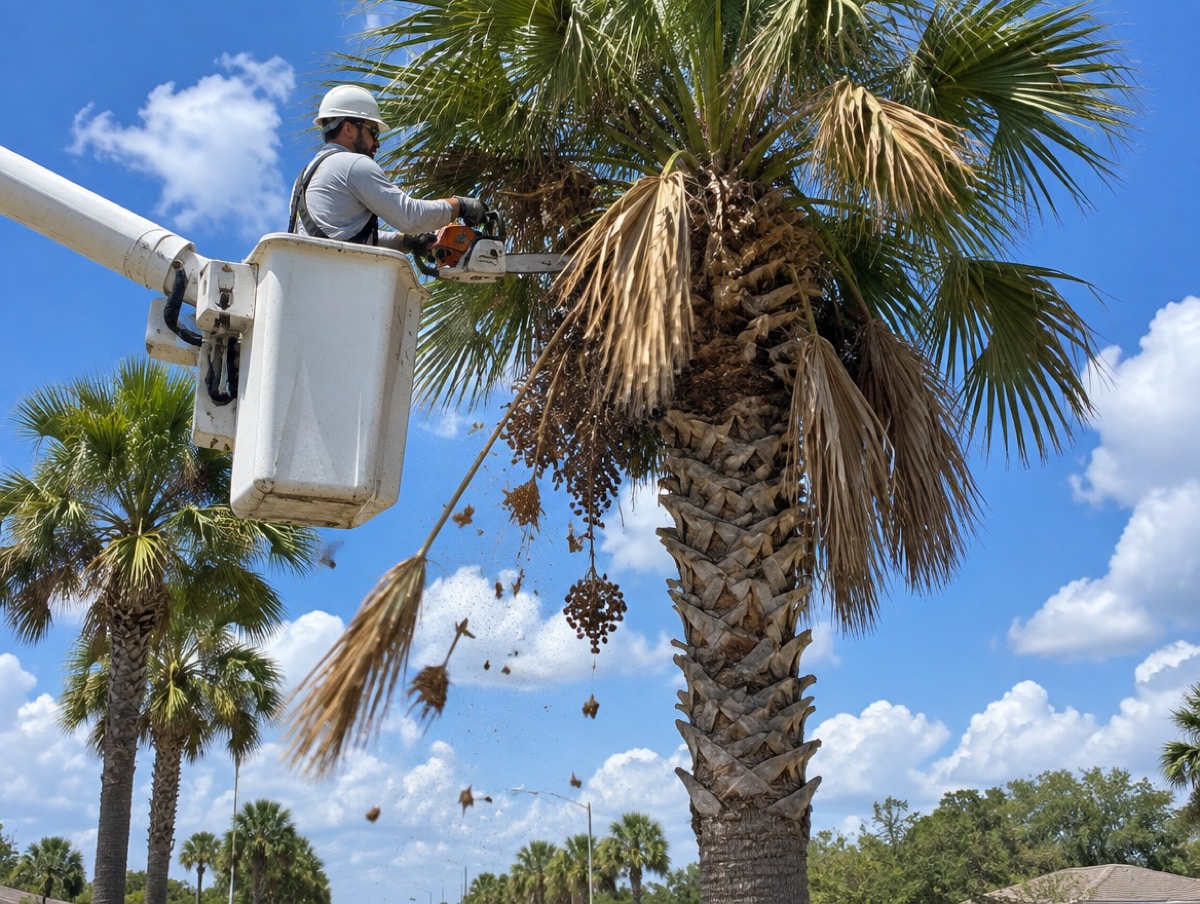
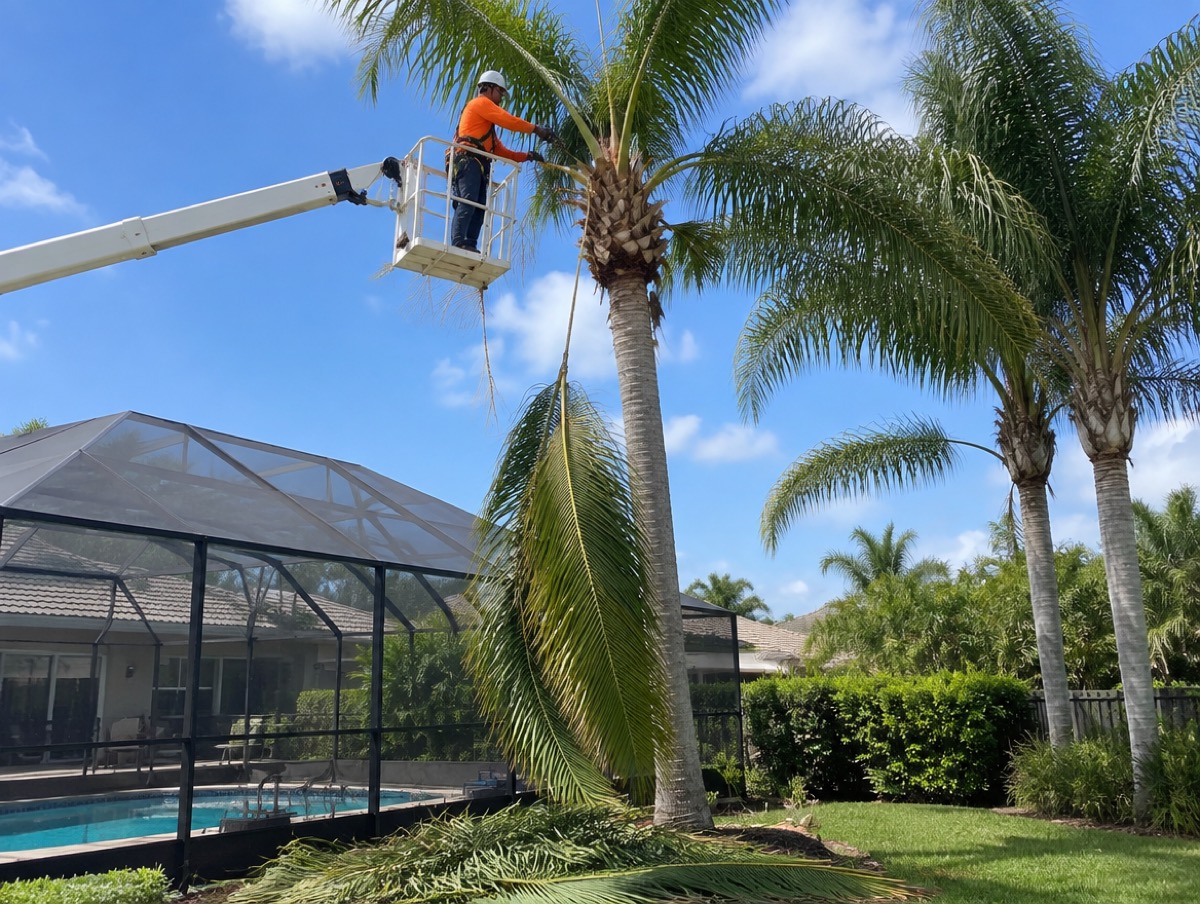
Climbing spikes leave wounds in a palm trunk that never heal and can become entry points for disease (EP443). On a palm that's staying, ask the crew you're matched with how they'll reach the crown. A bucket lift or ladder does the job without spikes.
A frond that doesn't come off easily shouldn't be ripped away, since that also leaves an opening for disease (Gardening Solutions). When a palm may have a disease that spreads on tools, EP443 recommends soaking tools in a disinfectant solution for 5 minutes before using them on another palm.
Two diseases that mean the palm comes out
Ganoderma butt rot. UF/IFAS assumes all palms are susceptible. The sign is a conk, a hard, shelf-like fungal growth on the lower 4 to 5 feet of the trunk, though many infected palms die before one forms. There's no cultural or chemical control and no cure. UF/IFAS says to remove the palm as soon as conks appear, take out as much of the stump and roots as possible or grind the stump, and not to plant another palm in the same spot without special precautions, because the fungus survives in the soil. It isn't spread by pruning tools (UF/IFAS PP100).
It shows up close to home. In July 2026, Florida Tech in Melbourne reported a few campus palms with Ganoderma butt rot that would have to be removed (Florida Tech News).
Lethal bronzing. It's caused by a phytoplasma, a type of bacteria without a cell wall, and was found in Florida in 2006 and in cabbage palms in 2008. UF/IFAS lists 21 host species, including cabbage, queen, coconut and Christmas palms, and Brevard is on its list of counties with confirmed cases. Early signs are premature fruit drop or dead flower stalks. Then the oldest fronds discolor, and the end comes when the spear leaf collapses (UF/IFAS PP243).
Once a palm shows symptoms and tests positive, UF/IFAS says to remove it immediately, and to test nearby healthy palms and inject them with oxytetracycline every three to four months for at least two years. Sap-feeding insects spread it, and pruning tools don't (PP243).
If you suspect either one, your local UF/IFAS Extension office is the place to ask before anything is cut. The palm trimming and removal page covers what a removal involves.
Palms and permits
Palm Bay names palms directly: removing one with 4.5 feet or more of clear wood needs a permit unless an exception applies (Palm Bay Code s. 175.014). Titusville leaves palms out of its protected tree classes (Titusville LDR s. 30-31). Elsewhere, check the permit guide before a removal.
For trimming help, call or text (321) 604-1285 with a photo of the palm. We match you with an independent local crew.
Questions people ask
How often should palm trees be trimmed?
There's no one right time of year. UF/IFAS says you can prune palms whenever it's convenient, as long as only fully dead fronds come off (Gardening Solutions). To help pollinators, wait until the flowers drop before cutting fruit stalks.
Is a hurricane cut a good idea before storm season?
No. Hurricane-cut palms were more likely to lose their crowns in high wind (Gardening Solutions). Remove dead fronds and heavy fruit, and leave the green.
The oldest fronds on my palm are yellow. Should I cut them?
Can I plant a new palm where one died of Ganoderma?
UF/IFAS doesn't recommend it without special precautions, because the fungus survives in the soil (PP100).
Do royal palms need trimming?
Usually not. Royal palms have a crownshaft and drop their own old fronds about once a month (Gardening Solutions).
Sources
- UF/IFAS Gardening Solutions, Pruning Palms
- UF/IFAS, Pruning Palms (ENH1182/EP443)
- UF/IFAS, Wind and Trees: Lessons Learned from Hurricanes (FR173)
- UF/IFAS, Queen palm fact sheet (ST609)
- Florida Statutes s. 15.031, State tree
- UF/IFAS, Ganoderma Butt Rot of Palms (PP54/PP100)
- UF/IFAS, Lethal Bronzing Disease (PP243/PP163)
- Florida Tech News, Several campus palms showing signs of lethal fungal infection (July 2026)
- NOAA AOML Hurricane Research Division, Hurricane FAQ
- Palm Bay Code s. 175.014, Tree removal and land clearing permits
- Titusville LDR s. 30-31, Definitions and tree classes